Department of Astronomy, University of Illinois Urbana-Champaign
I work with Yue Shen at UIUC on the coevolution of supermassive black holes and their host
galaxies, and on high-redshift transients. My research combines JWST, HST, and ground-based
imaging and spectroscopy to study galaxy formation and evolution, AGN outflows and feedback,
the dusty torus around accreting black holes, and supernovae in the early universe.
My work combines multi-wavelength imaging and spectroscopy — much of it from JWST — to
understand how active galactic nuclei and their host galaxies grow and evolve together
across cosmic time, and to discover and characterize high-redshift transients.
01
SMBH – galaxy coevolution
How black holes and their host galaxies grow together, from local ellipticals to quasars at cosmic noon.
02
Galaxy formation & evolution
The assembly and evolution of galaxies from the early universe to today, using deep imaging and spectroscopy.
03
High-z transients & supernovae
Time-domain discoveries of distant supernovae and transients, including with the NEXUS JWST survey.
04
AGN outflows & feedback
How energy and gas ejected by active galactic nuclei shape star formation in their host galaxies.
05
AGN dusty torus
The structure, geometry, and infrared signatures of the obscuring torus around accreting supermassive black holes.
Publications
I've published 16 first-author papers, 5 (co-)mentored papers, and ~40 contributed papers in total. Below are a few highlights; the full, up-to-date list is on SciX.
Research Highlights
2026 · arXiv:2609.38373
NEXUS: Discovery of a Luminous Young Transient at z = 5
M.-Y. Zhuang, Y. Shen, L. Hu, et al.
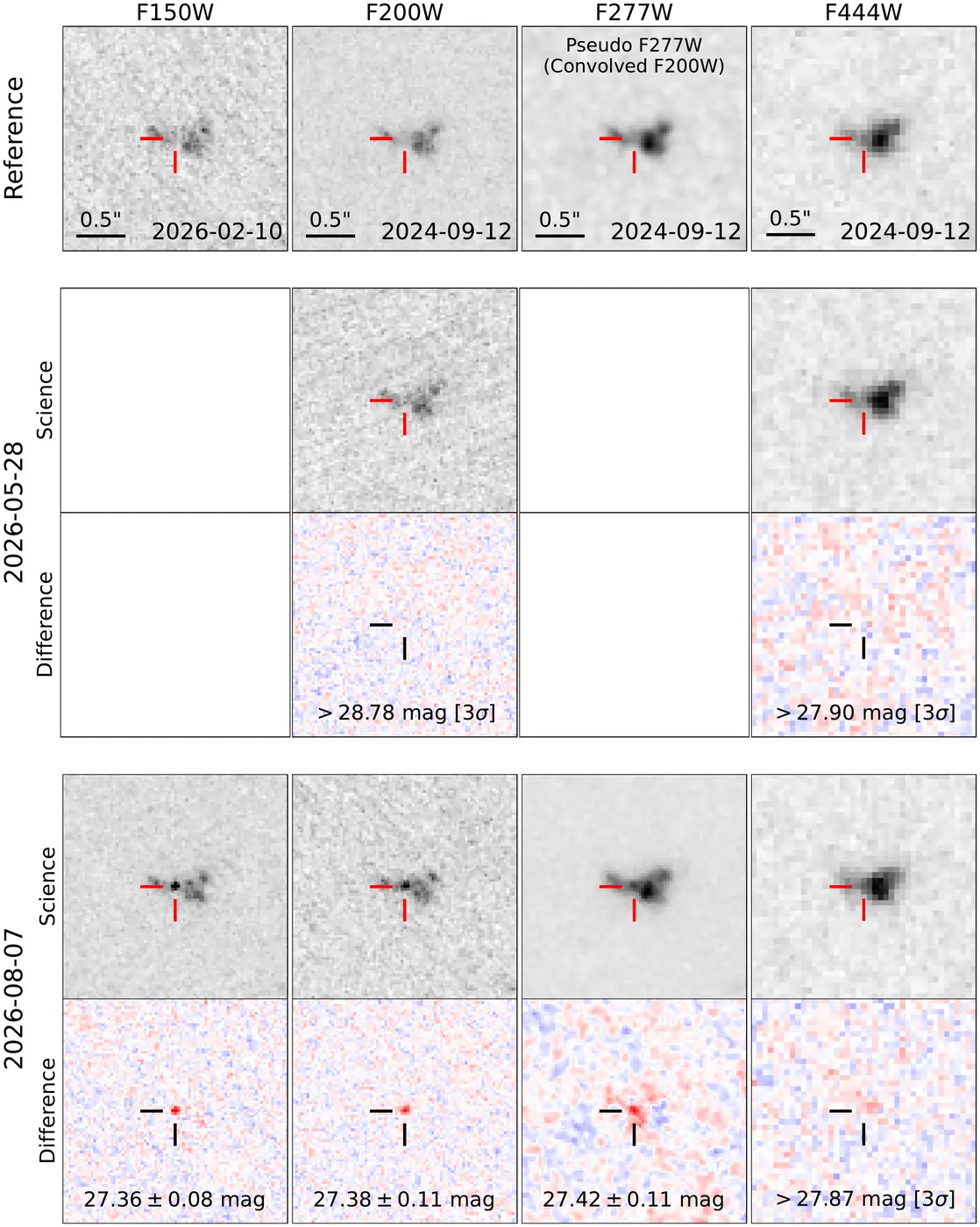
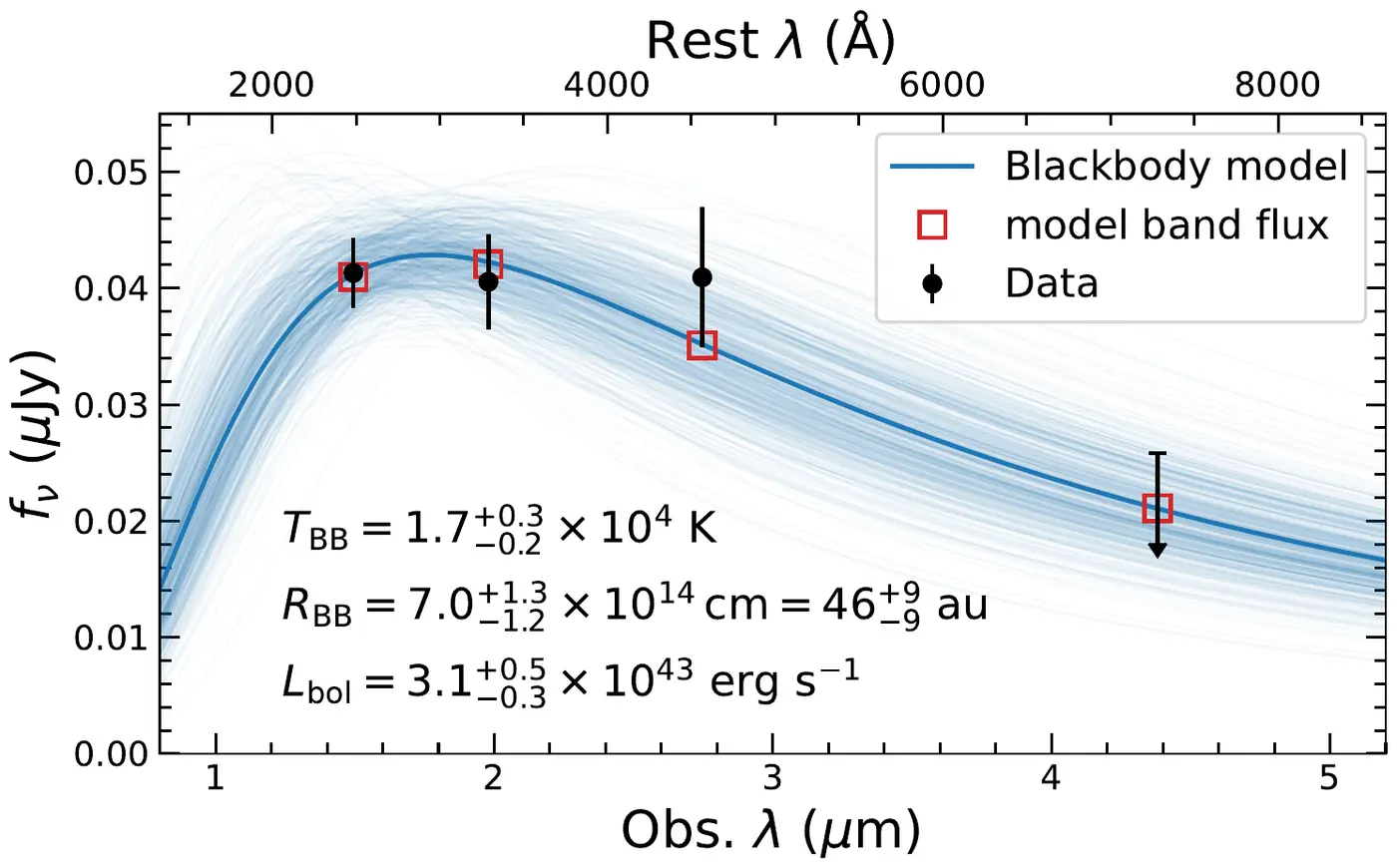
NIRCam reference, science and difference images: AT 2026abck appears on 2026 Aug 7, after a non-detection two months earlier.A blackbody fit to the discovery-epoch photometry: a hot (~17,000 K), UV-bright photosphere.
We report AT 2026abck, a transient in a star-forming galaxy at z = 5.017 found in NEXUS Year-2 NIRCam
imaging — the first robustly detected z > 5 transient in a field without gravitational lensing.
It brightened by more than 1.4 mag within ~12 rest-frame days, and its spectrum is consistent with a hot
(~1.7×10⁴ K) blackbody with a radius of ~46 au and a luminosity of ~3×1043 erg s−1.
Its offset from the galaxy center and its hot, UV-bright spectrum point to a core-collapse supernova caught only
~4–10 rest-frame days after explosion, hotter and more luminous than normal Type II supernovae at that phase.
The host is a typical star-forming galaxy (M* ≈ 109.8 M⊙), ~2000 times
more massive than the host of the lensed SN Eos at z = 5.13, showing that supernovae at z > 5
occur in a wide range of environments and that fast-cadence JWST blank-field surveys can catch them early.
NEXUS: Transient Searches and First Results from Year One Observations
M.-Y. Zhuang, L. Hu, J. D. R. Pierel, et al.
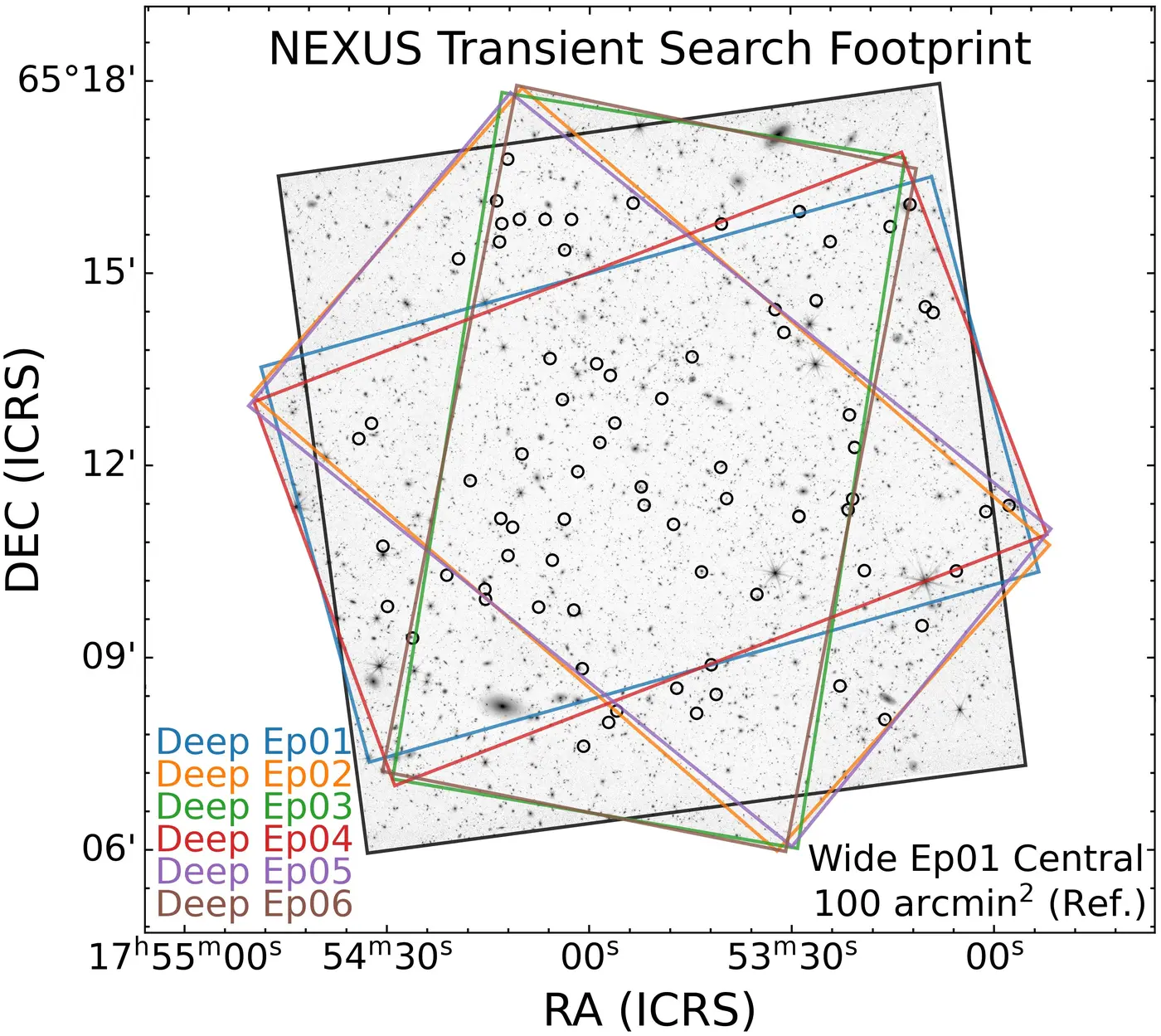
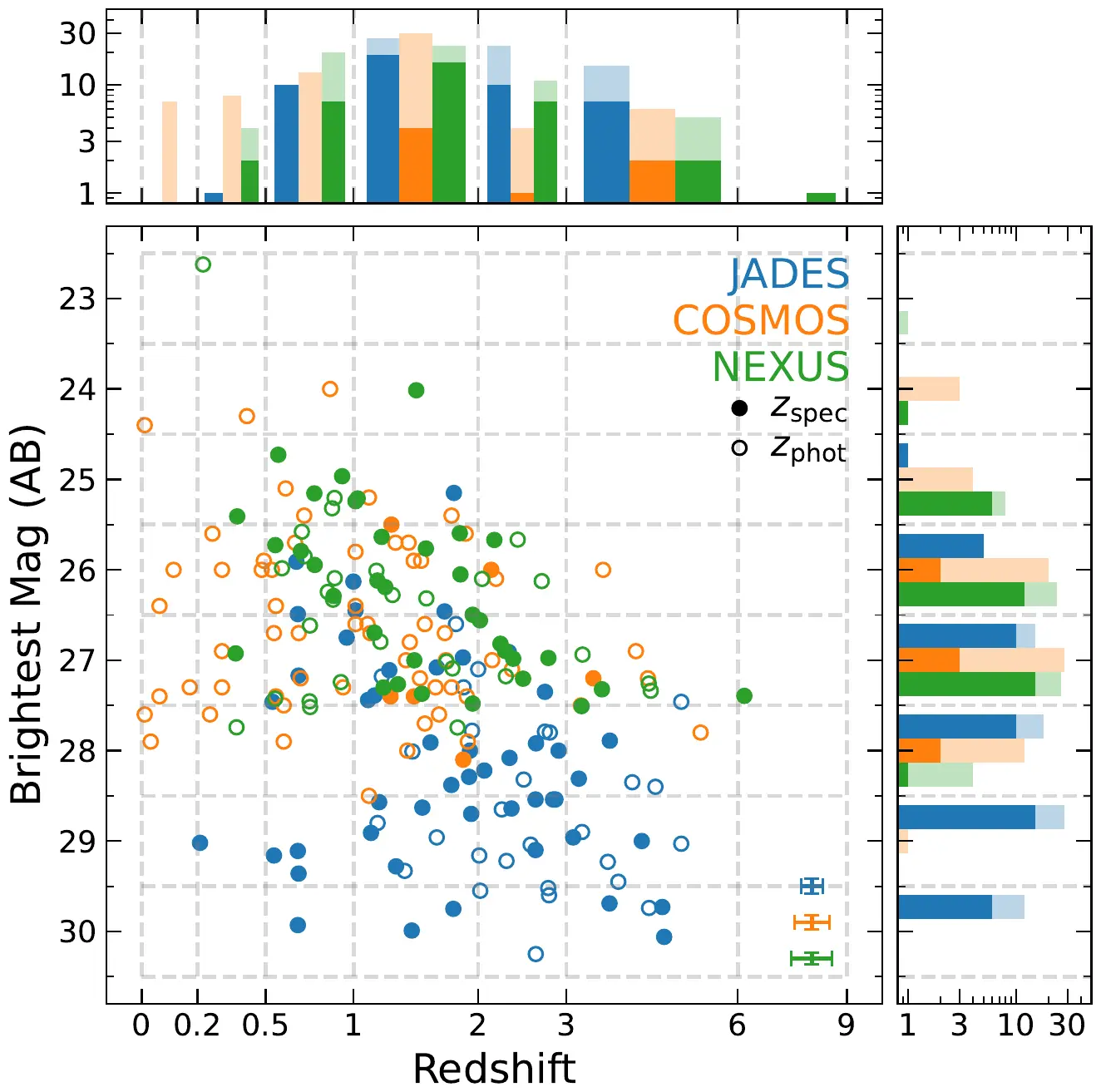
The NEXUS-Deep transient-search footprint over six epochs, with the Year-1 transients circled.Peak magnitude versus redshift of supernovae from the NEXUS, JADES and COSMOS transient surveys.
We present the transient search in NEXUS, a multi-cycle JWST Treasury program in the North Ecliptic Pole field, using
NIRCam F200W+F444W imaging taken every ~2 months over ~61.5 arcmin2, plus NIRSpec/PRISM spectroscopy.
In the first year we found 68 robust transients, with host photometric redshifts reaching z ≈ 6, and secured
spectroscopic redshifts for 37 of them (~54%), including a tentative host association at z = 6.151.
NEXUS finds supernovae most efficiently of all JWST surveys so far, at 6.6 per hour of imaging (2.6× COSMOS and 26× JADES),
while its supernova rates broadly agree with other programs. We describe the reduction and detection pipeline in detail
and release jwst_psfmc, a PSF photometry package that accounts
for the correlated noise between pixels introduced by drizzling.
NEXUS: A Spectroscopic Census of Broad-line AGNs and Little Red Dots at 3 ≲ z ≲ 6
M.-Y. Zhuang, J. Li, Y. Shen, et al.
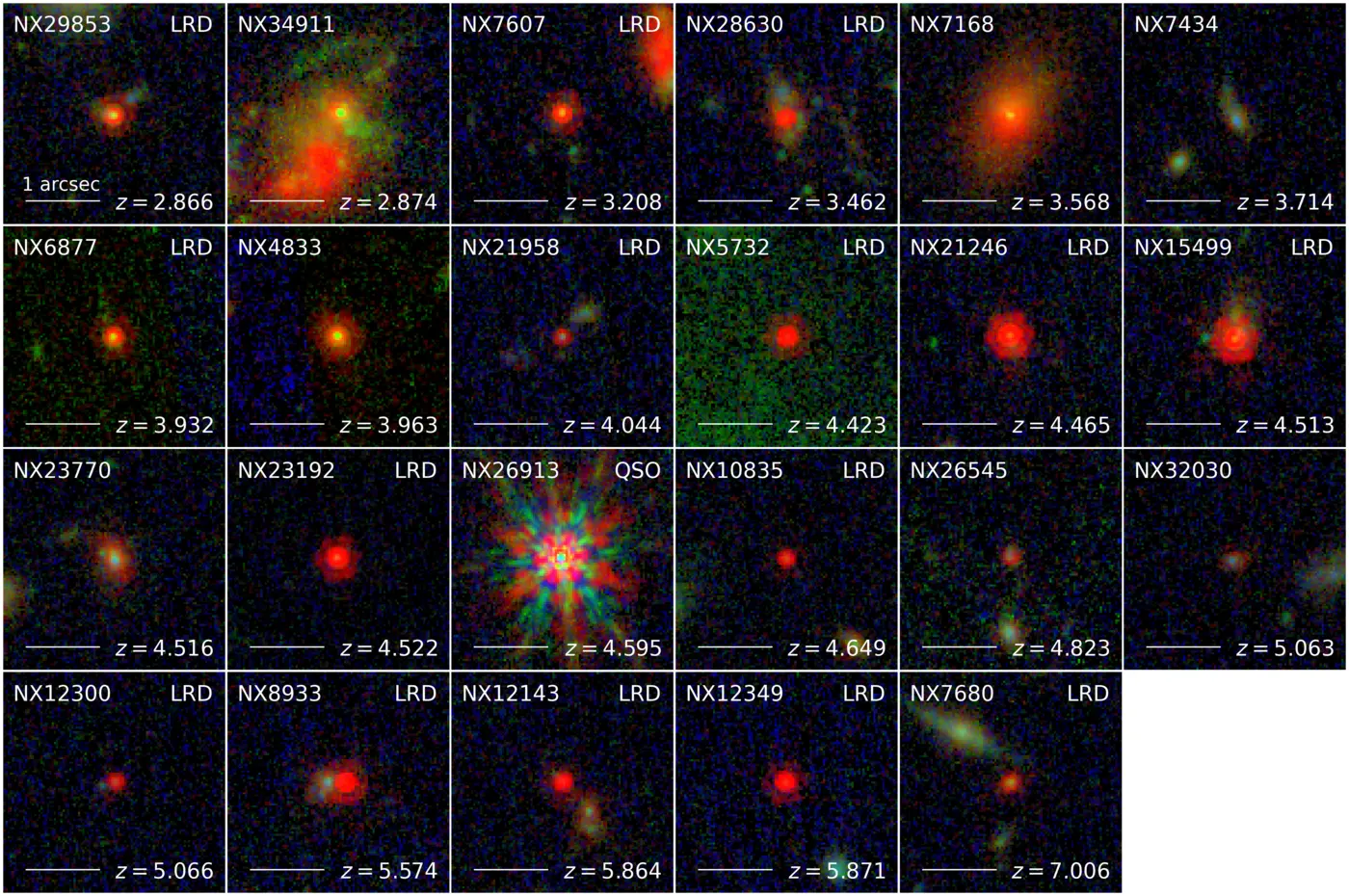
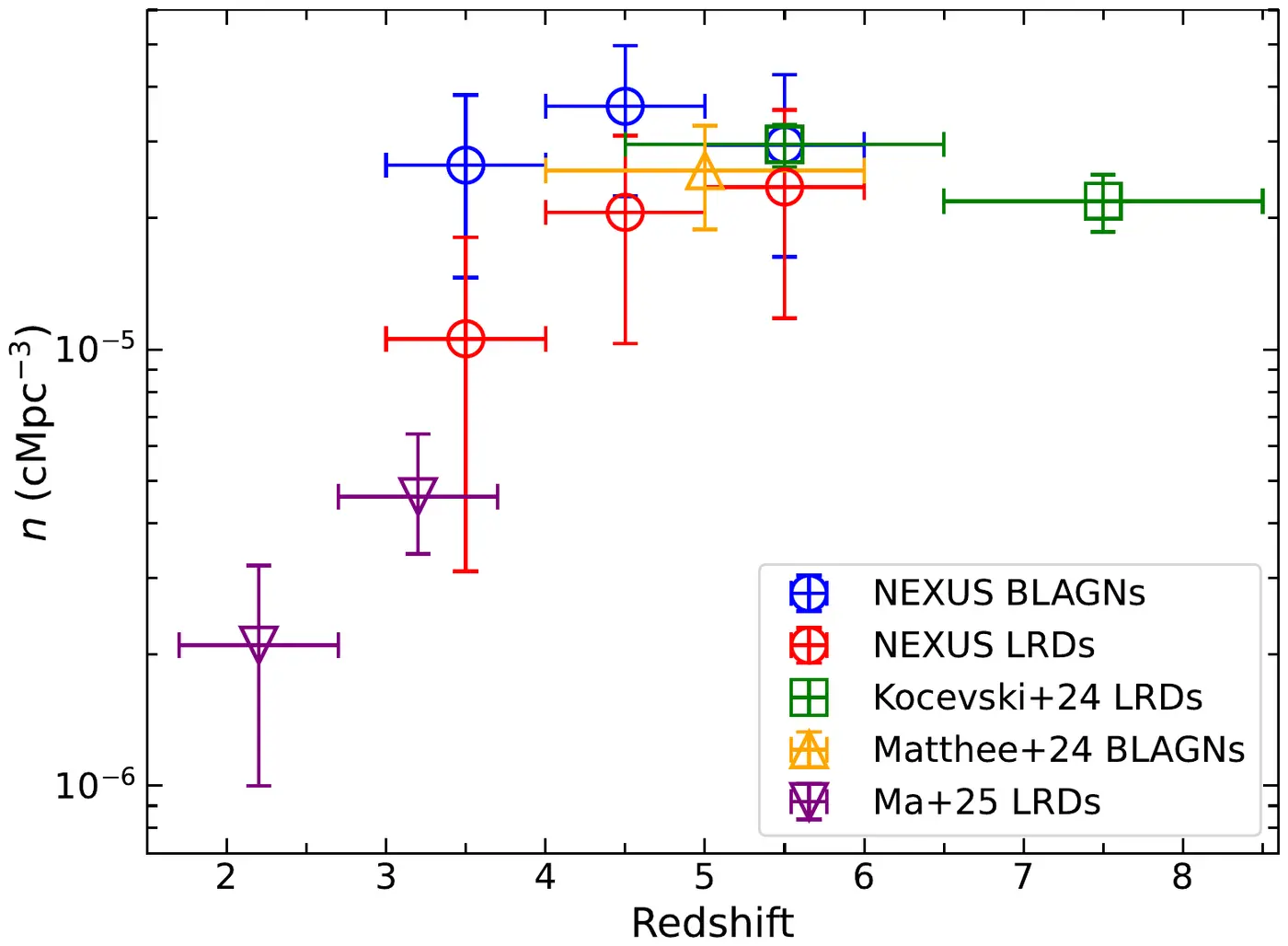
Color (F090W+F200W+F444W) images of the broad-line AGNs found with NIRCam grism spectroscopy; Little Red Dots are labeled “LRD”.Number density of broad-line AGNs and LRDs versus redshift, compared with other surveys.
Using NIRCam grism (WFSS) spectroscopy of the central 100 arcmin2 of NEXUS, we identify 23 broad-line AGNs at
3 ≲ z ≲ 6, 15 of which are “Little Red Dots” (LRDs). LRDs have a number density of
~10−5 cMpc−3, which hints at a decline toward the lower end of this redshift range, and
black-hole masses of ~106.3–8.4 M⊙. Half of the LRDs show strong Balmer absorption, a sign of dense
gas around the broad-line region. In most LRDs we detect extended host-galaxy light (hundreds of parsecs across)
that contributes much, or even most, of the UV emission, largely explaining the puzzling UV upturn in LRD spectra.
Their small-scale clustering suggests LRDs may be more strongly clustered than their low space density would imply.
Active Galactic Nuclei and Host Galaxies in COSMOS-Web. I. NIRCam Images, PSF Models and Initial Results on X-Ray-selected Broad-line AGNs at 0.35 ≲ z ≲ 3.5
M.-Y. Zhuang, J. Li, Y. Shen
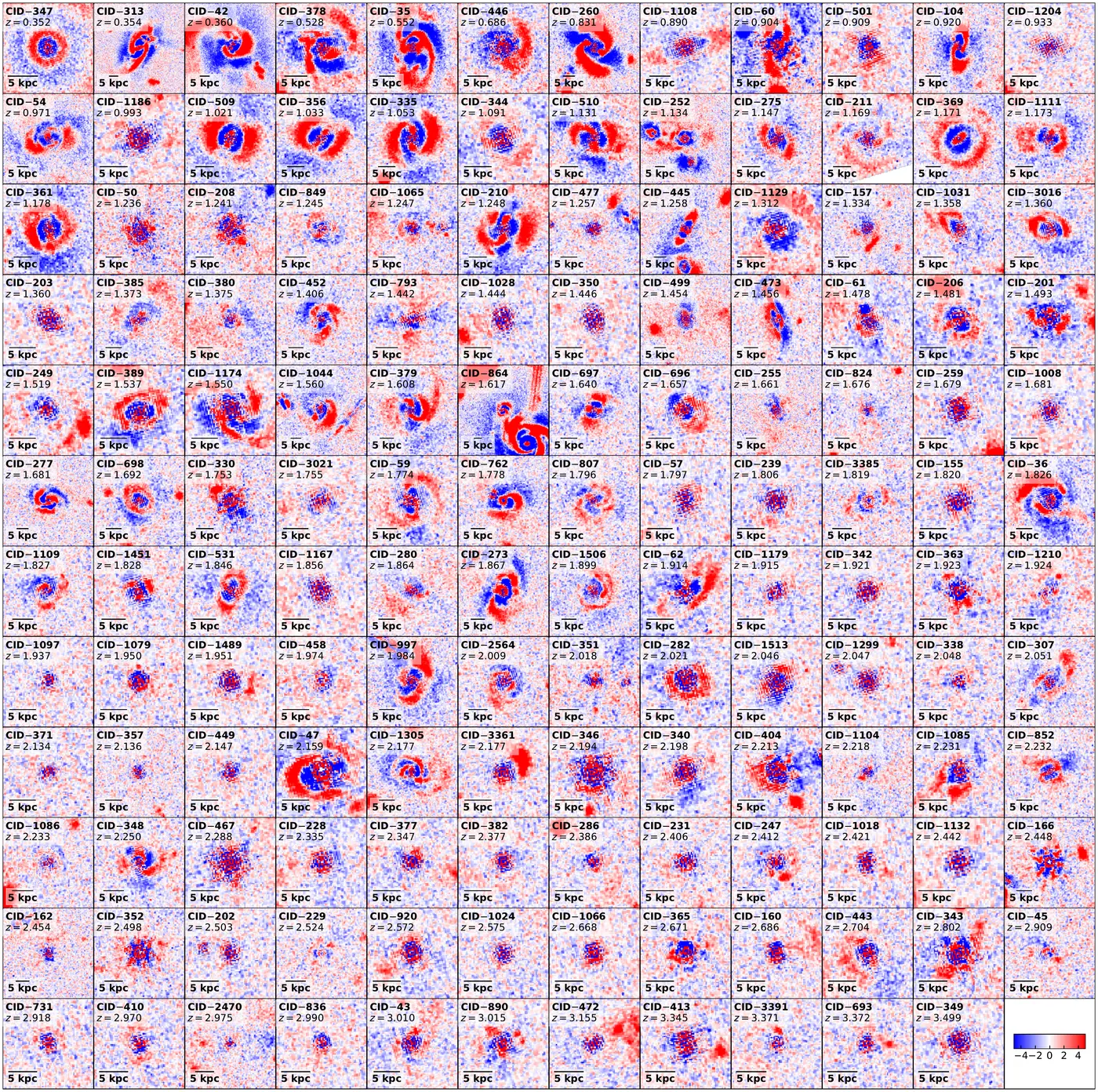
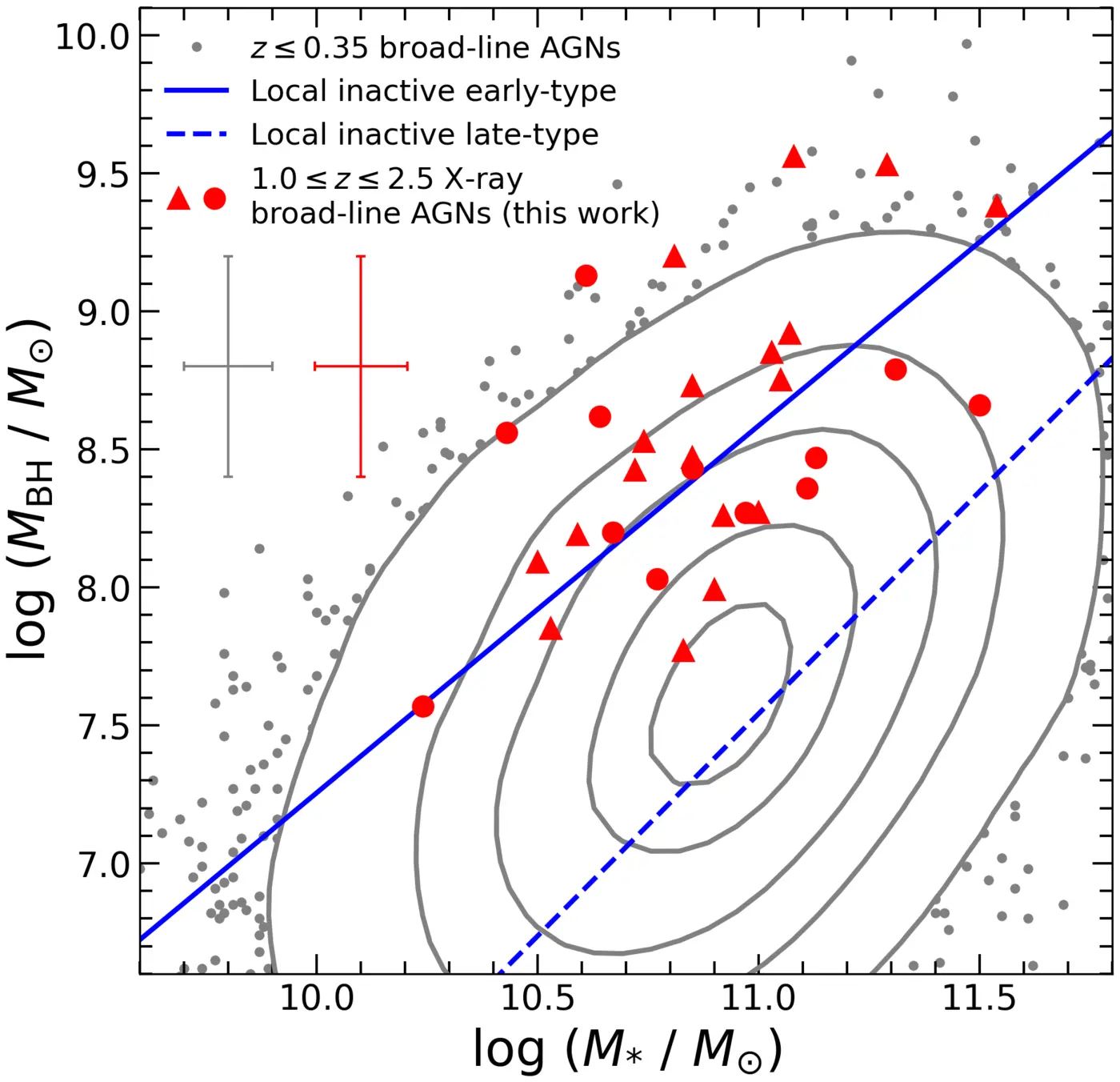
F277W images left over after subtracting the AGN and smooth host models reveal bars, spiral arms and tidal features. Click to enlarge.Black-hole mass versus host stellar mass for AGNs at 1 ≤ z ≤ 2.5 (red), compared with nearby AGNs (gray).
We reduced all public COSMOS-Web NIRCam imaging available by mid-2023 (0.28 deg2) and built PSF models for it, finding
that the NIRCam PSF changes noticeably over short times and varies randomly across the field. Combining NIRCam with
archival HST imaging, we separate the central point source from the host galaxy for 143 X-ray-selected broad-line
AGNs at 0.35 ≲ z ≲ 3.5, detecting host starlight in 142. About two-thirds of the hosts are
star-forming, showing no sign that the AGN is shutting down star formation at the time we observe it, and the hosts follow nearly the same mass–size relation as
galaxies without an AGN. Major mergers are rare (~7–22%), but bars, spiral arms and signs of minor mergers are everywhere,
pointing to secular processes and minor mergers as important triggers of AGN activity.
Evolutionary paths of active galactic nuclei and their host galaxies
M.-Y. Zhuang, L. C. Ho
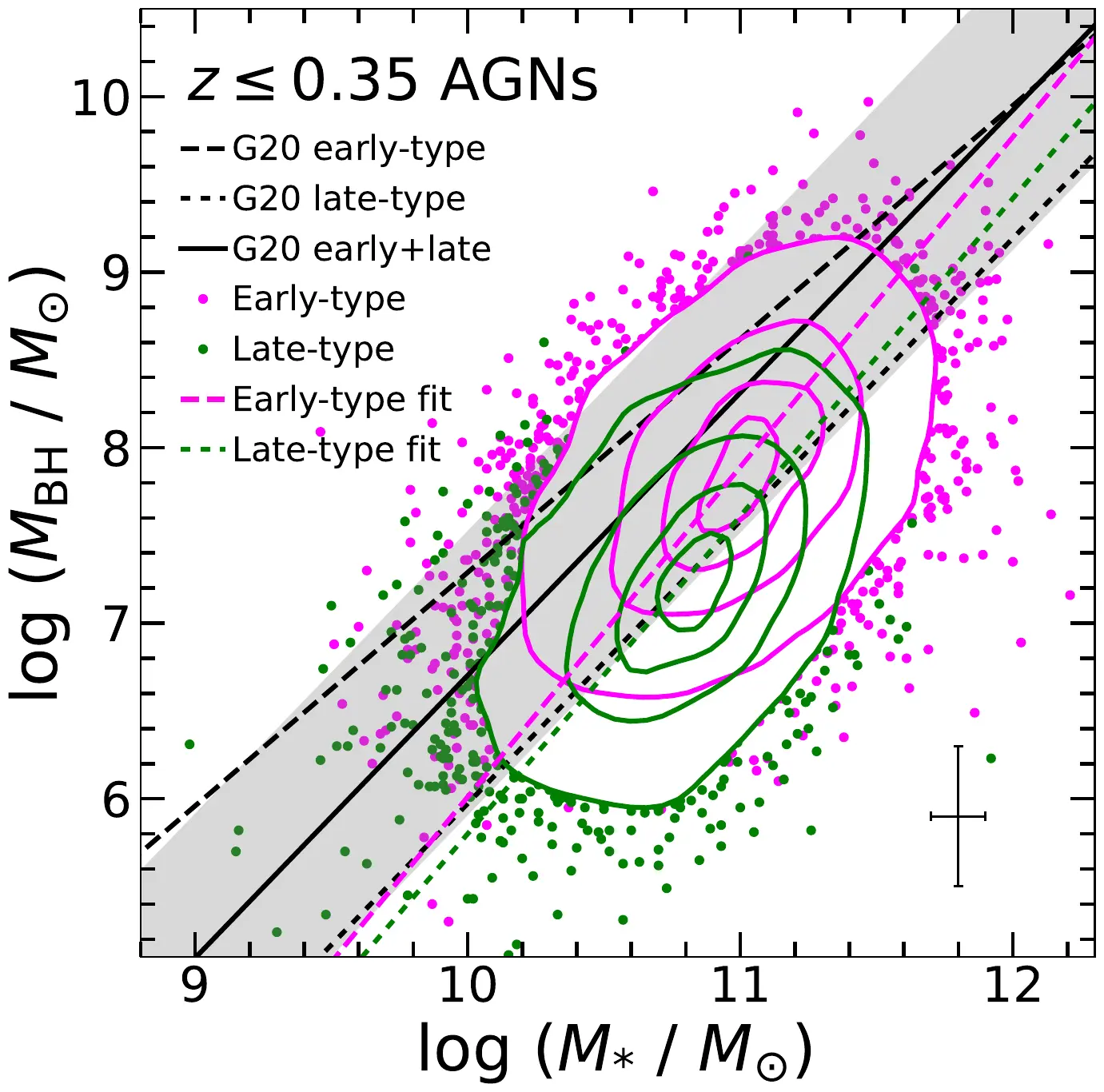
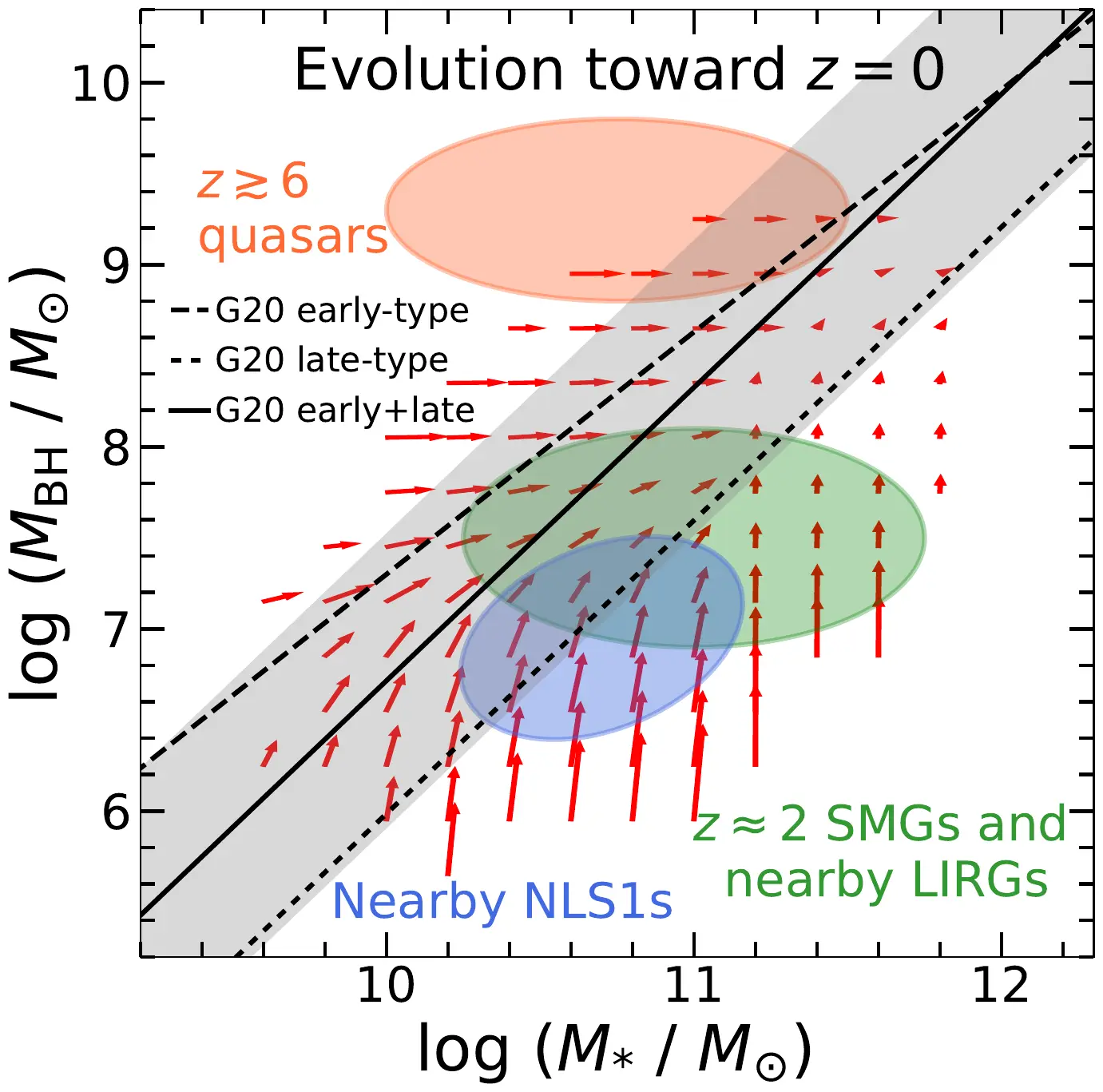
The black-hole mass–stellar mass relation of early-type (magenta) and late-type (green) AGN hosts at z ≤ 0.35.How AGNs are expected to move on the black-hole mass–stellar mass plane as they evolve to z = 0.
We measured stellar masses, colors and structures for the host galaxies of ~11,500 broad-line AGNs at z ≤ 0.35,
a sample nearly 40 times larger than any before it. Early- and late-type AGN hosts follow a similar relation between black-hole
mass and stellar mass, and where an AGN sits on this plane is tied to its star formation and black-hole growth.
This points to distinct evolutionary paths: galaxies above the relation mainly grow in stellar mass, those on it move
along it, and those below it mainly grow their black holes. These paths suggest that radiative-mode feedback cannot quench the growth of AGNs below the relation,
while kinetic-mode feedback hardly suppresses long-term star formation in those above it.